
This manual contains important information regarding safety, usage, and maintenance
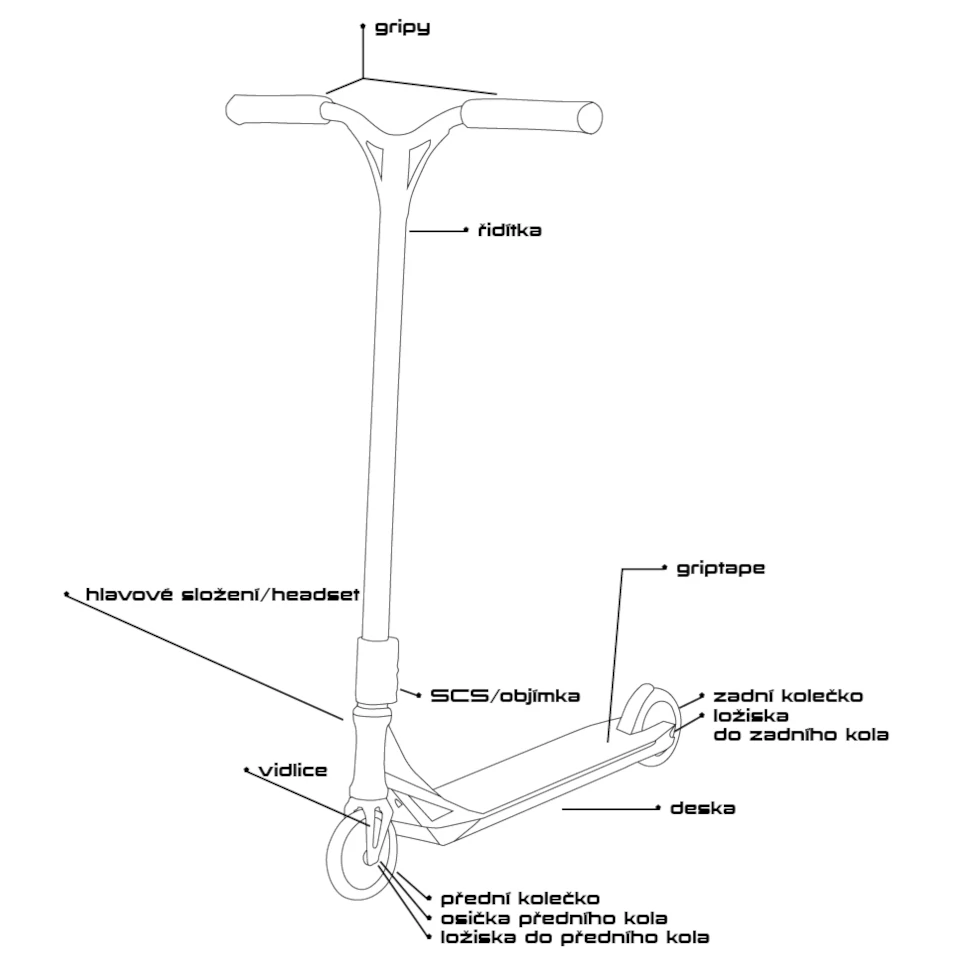
1) SCOOTER COMPONENTS
2) SAFETY INSTRUCTIONS
- Always wear a helmet and other protective gear, i.e., elbow, knee, and wrist pads. The helmet must always be fastened!
- Always wear sturdy, closed-toe shoes.
- Ride on smooth, paved surfaces away from motor vehicles. Avoid sharp bumps, storm drains, gutters, and sudden surface changes; the scooter can stop abruptly.
- Avoid surfaces covered with sand, gravel, dirt, leaves, and other debris.
- Under all circumstances, avoid water or using the scooter in rainy conditions. Rainy weather affects traction, braking, and visibility. Do not use the scooter in the dark or in poor lighting conditions.
- Avoid steep hills, descents, and excessive speed associated with downhill riding.
- The brake becomes hot with intensive use. Do not touch the brake immediately after use.
- Follow local traffic regulations. Pay attention to other road users and pedestrians.
- Do not use the scooter if it shows signs of damage. Replace worn or broken parts immediately.
- Check the technical condition of the scooter before every ride. Check that all bolts, axles, the headset, and the compression system are tightened. There must be no play (looseness) in the scooter components.
- Children should only ride under constant adult supervision.
- The scooter is intended for only one rider.
- Do not overestimate your skills while riding and use common sense. Beginners should definitely familiarize themselves with how the scooter handles in a flat, empty area and learn the basics of riding (starting, turning, braking, jumping off).
3) ASSEMBLY INSTRUCTIONS
Adult assistance is required for assembly. The scooter is partially pre-assembled at the factory. Final assembly consists of attaching the handlebars to the fork to create the complete unit.
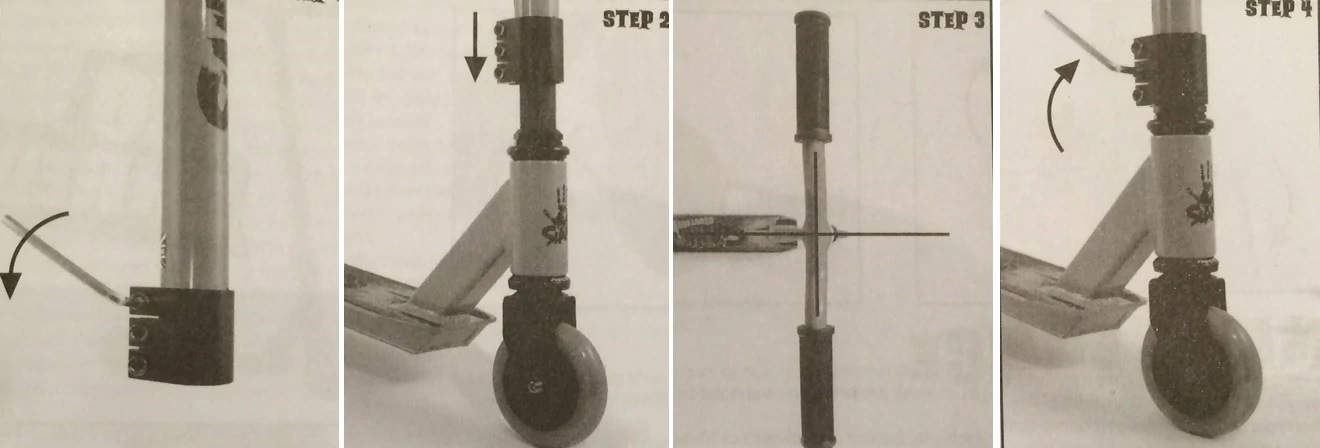
Assembly of a scooter with a threaded fork
1) Loosen the bolts on the clamp that is placed on the handlebars
2) Place the handlebars, including the clamp, onto the fork as low as possible
3) Align the handlebars so that the front wheel is straight in the direction of travel
4) Once the wheel is aligned, tighten the bolts on the clamp. It is important to tighten the bolts gradually, not in a crisscross pattern
5) Only when you are sure that all bolts are tightened can you set off
Assembly of a scooter with an ICS compression system (a thread is installed inside the handlebars)
1) Remove the front wheel (if not already removed)
2) Loosen the bolts on the clamp that is placed on the handlebars
3) Place the handlebars, including the clamp, onto the fork as low as possible
4) Using a long Allen key, insert the included bolt into the fork and screw it into the installed thread in the handlebars. Use this bolt to adjust the steering tension.
5) Align the handlebars so that the front wheel is straight in the direction of travel
6) Once the wheel is aligned, tighten the bolts on the clamp. It is important to tighten the bolts gradually, not in a crisscross pattern
7) Only when you are sure that all bolts are tightened can you set off
Assembly of a scooter with an HIC compression system (a shim attached to the fork via a washer and a short bolt) and a scooter with IHC (same as HIC, only with a smaller outer diameter)
1) Loosen the bolts on the clamp that is placed on the handlebars
2) Place the handlebars, including the clamp, over the shim that is placed on the fork as low as possible
3) Align the handlebars so that the front wheel is straight in the direction of travel
4) Once the wheel is aligned, tighten the bolts on the clamp. It is important to tighten the bolts gradually, not in a crisscross pattern
5) Only when you are sure that all bolts are tightened can you set off
Assembly of a scooter with an SCS compression system (a "clamp" attached to the fork via an internal shelf and bolt)
1) Loosen the bolts on the SCS that is attached to the fork
2) Insert the handlebars into the SCS as low as possible
3) Align the handlebars so that the front wheel is straight in the direction of travel
4) Once the wheel is aligned, tighten the bolts on the SCS. It is important to tighten the bolts gradually, not in a crisscross pattern
5) Only when you are sure that all bolts are tightened can you set off
On a brand new scooter, out of the box, the wheels may not spin smoothly. Bearings need to be broken in and will always spin smoothly under load.
4) MAINTENANCE
To ensure proper functionality and a long service life, observe these rules:
Always keep the scooter in a dry place.
After each use, clean the scooter with a soft, damp cloth. Do not use detergents or other cleaning agents.
If the scooter gets wet, dry all metal parts to prevent corrosion.
Wheel bearings are sealed and do not require lubrication. However, they benefit from occasional cleaning with a soft, damp cloth to remove dust and any metal shavings.
Wheels should be replaced if they are worn or broken. You can extend the lifespan of your wheels by rotating the front and rear wheels and by using the brake correctly.
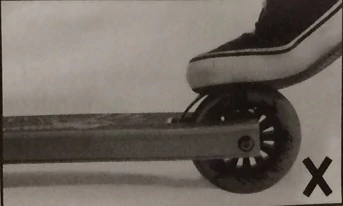
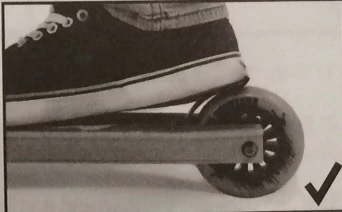
Correct use of the brake prevents flat spots from forming on the rubber of the rear wheel. Do not "slam" the brake and cause the rear wheel to skid.
5) ADDITIONAL WARNINGS
- The scooter is not immune to damage. Individual parts are subject to wear.
- Please keep in mind that the statutory warranty period (the period for asserting rights from defective goods) should not be confused with the lifespan of the goods, i.e., the time during which, given proper use, care, and maintenance, the goods can last depending on their properties, intended purpose, and intensity of use. The lifespan of products designed for extreme sports involves susceptibility to wear and tear caused by normal use.
- Scooters are tested according to EN 14619 standards.
Distributor: Scoot Trade s.r.o., Bubenské nábřeží 306/13, Hall no. 11, 170 00 Prague 7 – Holešovice, VAT ID: CZ02902524, Czech Republic