
FREESTYLE SCOOTER FORKS
If you want to learn something about freestyle scooter forks, you must first be willing to engage in a nearly forgotten activity – reading.
Forks are one of the components of a freestyle scooter. It is important to realize that while freestyle scooter forks are designed for freestyle riding and are inherently durable, they are NOT indestructible. Just like any human activity, riding a freestyle scooter requires engaging your gray matter. Then there is another possibility: you have to change the laws of physics or the periodic table of elements. :-)
Forks are made of CrMo (steel) or aluminum. The vast majority of threadless forks (see below) available on the market are made of aluminum. Aluminum forks are lighter than steel forks and, paradoxically, also stronger.
FORKS CAN BE CATEGORIZED ACCORDING TO VARIOUS CRITERIA
a) Material
Aluminum vs. CrMo (steel)
b) Threaded vs. threadless forks
Threaded forks (the fork steerer tube is threaded) are used only on the cheapest scooters for beginners. They are practically non-existent on the components market. Threaded forks are always made of steel and are two-piece. Due to the thread, the wall of the tube is weakened, making them less strong. They are not suitable for use with pegs.
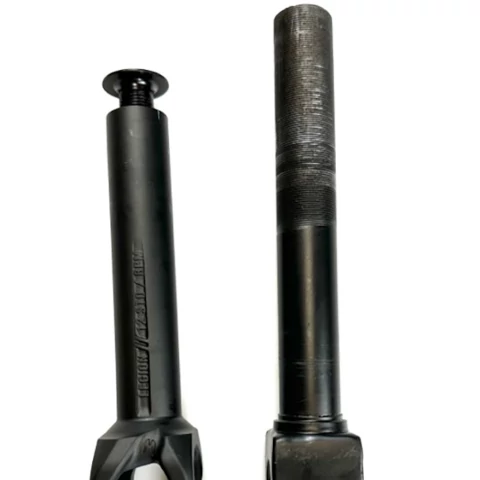
c) One-piece vs. two-piece forks
The vast majority of forks available on the market are one-piece forks. They are made from a single piece of aluminum using various manufacturing processes. Forks made this way have no welds and are therefore stronger.
To summarize points a) through c), the vast majority of forks sold separately are aluminum, threadless, and one-piece.
d) Offset
Offset refers to whether the fork axle is in line with or offset from the axis of the fork tube.
Forks are divided into so-called Zero Offset forks (the fork axle is in line with the fork tube axis) and Offset forks (the fork axle is offset from the fork tube axis). The vast majority of forks have a very similar offset. There are very few Zero Offset forks on the market.
Offset forks make handling the scooter smoother.
Zero offset forks are more playful, while offset forks are more comfortable.
e) Compatibility with different wheel diameters
Currently, wheels of various diameters are offered on the market: 100mm, 110mm, 115mm, 120mm, and 125mm.
Presumably, all currently available threadless & one-piece forks are compatible with 100 mm and 110 mm diameter wheels. That is the standard.
A relatively high percentage of forks can also accommodate 120 mm or 125 mm diameter wheels.
If you want to use 120 mm or 125 mm diameter wheels on your scooter, you must choose the correct fork model, as well as the correct deck!
Threaded, steel & two-piece forks used on entry-level scooters are mostly compatible only with 100 mm diameter wheels.
f) Compatibility with compression systems
For forks using HIC/SCS compression systems, the length of the fork tube is important.
When using SCS, the fork tube must not protrude from the headset by more than 3 - 5 cm, see the following video:
When using the HIC system, it is similar, only the fork tube must not protrude from the headset more than the length of the HIC shim, which is generally 4 - 5 cm long. Therefore, an HIC fork tube can be longer than an SCS fork tube.
An ICS fork tube can be any length. However, it should not be shorter than 4.5 cm for the proper function of the clamp and to cover the slit in the handlebars.
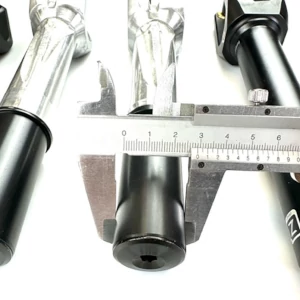
Standard ICS / HIC / SCS forks have an outer tube diameter of 28.7 mm.
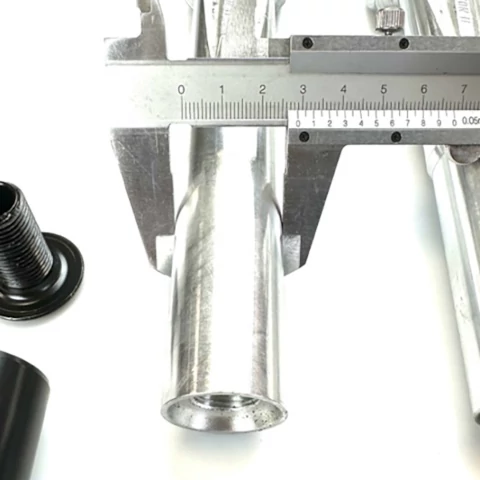
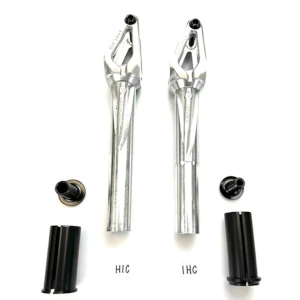
IHC forks are different. These forks have an outer tube diameter of approximately 25 mm (diameters vary by manufacturer, but are approximately 25 mm). By using an IHC shim, which has the same function as an HIC shim, a standard tube diameter of 28.7 mm is achieved.
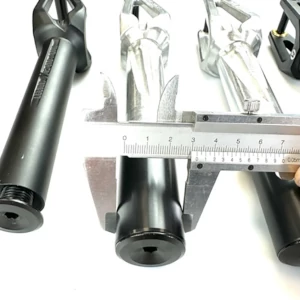
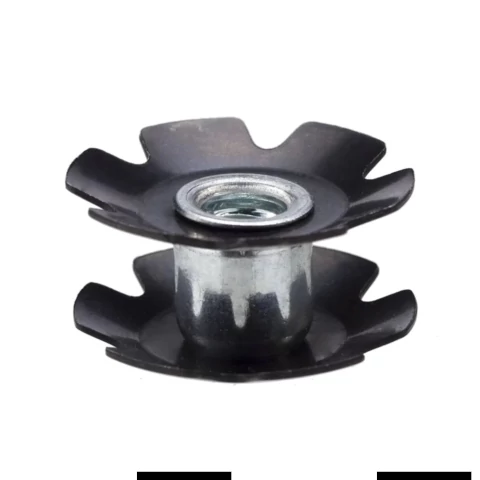
The vast majority of HIC and SCS forks have a pre-installed thread inside the tube. If you are unlucky and own a fork without a pre-installed thread, it's not the end of the world. In such a case, use a star nut, see or .
A 1 1/8" star nut is used for steel forks, while a 1" star nut is used for aluminum forks.
HOW TO EXTEND THE LIFE OF YOUR FORK
1) Treat your scooter with respect. Do not throw it around.
2) Perform tricks cleanly. The more you cushion the landing with your knees, the more you save the fork.
3) Use your chosen compression system correctly, see Compression Systems.
4) Using pegs protects the fork from excessive wear from grinding.
5) Do not lend your scooter to friends. They may weigh 30 kg more and have a completely different riding style.
HOW TO CHOOSE THE RIGHT FORK
1) Aluminum or steel
Unless you are a masochist, get an aluminum fork. After all, the selection of threadless steel forks is very limited.
2) Fork for SCS, HIC, IHC, or ICS?
When choosing a new fork, you must take your existing compression system into account. In general, HIC forks and SCS forks can be combined with each other. ICS forks are mostly compatible (sometimes after minor modifications) with SCS/HIC compression systems. IHC forks cannot be used with any other compression system.
3) Zero offset or offset?
Offset forks make handling the scooter smoother.
Zero offset forks are more playful, while offset forks are more comfortable.
What does the crowd choose? At least 98% of forks sold are offset forks.
4) Watch out for the headtube length of the deck!
More information in the video tutorial: