
PRO SCOOTER DECKS
If you want to learn something about pro scooter decks, first and foremost, you must be willing to perform a now nearly forgotten activity – reading.
Decks are one of the components of pro scooters. It is important to realize that while pro scooter decks are designed for freestyle riding and are inherently durable, they are NOT indestructible. Just like any human activity, riding a pro scooter requires the engagement of your gray matter. Then there is another option: you must change the laws of physics or the periodic table of elements. :-)
Decks are made of aluminum. Aluminum is a metal that is softer in its composition than many other metals or materials (minerals) that the deck comes into contact with.
Keep in mind that constant grinding on the same side of the deck will thin (wear down) the material on the bottom of the deck, even within just a few months, to such an extent that the deck's strength will be compromised.
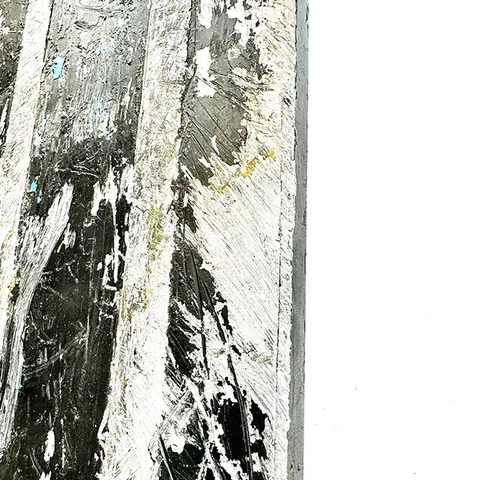
However, this is not a product defect; it is normal wear & tear. As an example, we can cite car tires. You buy expensive tires designed for fast, sporty driving, but if you go drifting with the car, you can easily destroy the whole set of tires in one day.
Static and dynamic loading are two different quantities. While static load is usually stated as 100 kg (in reality, the deck can carry an elephant), the riding style has a major influence on dynamic load. Hard, unabsorbed landings when performing tricks, where all kinetic energy is transferred to the deck, significantly shorten the life of the deck and are harmful not only to the deck but also to the rider's joints. When landing on an obstacle or the ground, it is necessary for the rider to soften the landing by bending their knees.
It must be realized that a pro scooter uses only two small non-pneumatic wheels, whereas, for example, BMX bikes use two large pneumatic tires along with a robust frame. Skateboards, on the other hand, use four wheels. The distribution of impact energy is therefore significantly different in the case of pro scooters.
There is no equivalence between the price of a deck and its strength. Expensive decks may feature, for example, the materials used, balance, unique design, and especially low weight, which can be up to 40% lower than that of cheap types of decks. It must be taken into account that a very light and perfectly balanced deck does not achieve the same lifespan as a deck that is twice as heavy. Very light decks require special handling, i.e., executing tricks cleanly and making correct landings.
Everyone has different needs. And this also applies to the weight of decks or scooters in general. For some, every gram is important and the weight of the deck is priority number one. Some people prefer heavier decks.
Decks do not benefit from traveling around the city or daily commuting to school on sidewalks of questionable quality. Other types of scooters, such as those with pneumatic tires, are suitable for traveling around the city. Using pro scooters for commuting around the city can result in loose screws, damaged headsets, or wheels.....
Pro scooters or rather decks should ideally be used on smooth surfaces.
DECKS CAN BE CATEGORIZED ACCORDING TO VARIOUS CRITERIA
a) Headset type
Decks with an integrated head tube and a standard head tube.
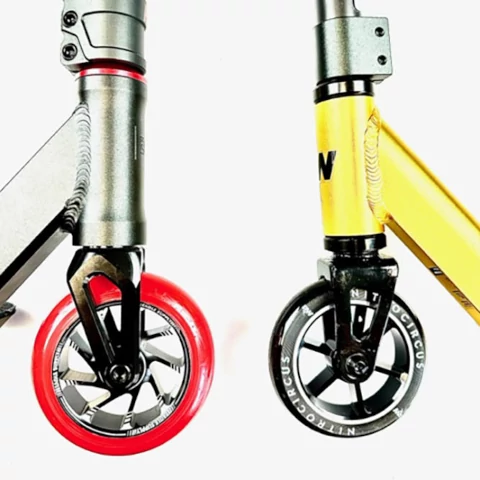
Decks with an integrated head tube use integrated headsets. Decks with a standard head tube use standard headsets. The vast majority (99%) of decks sold separately are manufactured with an integrated head tube. Integrated head tubes are simply the standard. Period. At the Gizmania store, you can only buy decks with an integrated head tube. Decks with a standard head tube are only used on cheap scooters for beginners, but they are practically not sold separately.
Switching from a deck with a standard head tube to a deck with an integrated head tube is difficult in terms of assembly, though not impossible. Contact us if you have any questions.
b) One-piece neck vs. two-piece neck
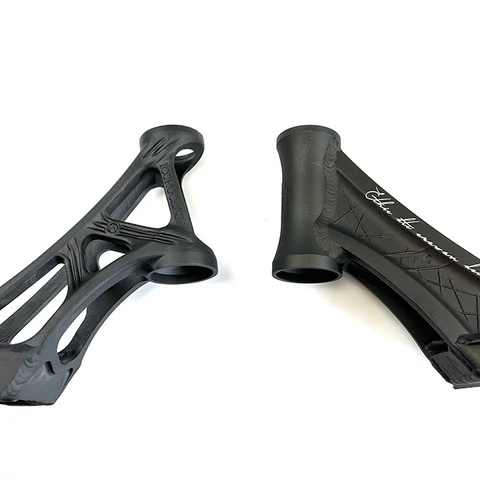
Decks with a one-piece neck have the *neck + headtube* section made from a single piece, also known as a monoblock. Most are forged parts. Some manufacturers mill necks from a single piece of aluminum. No weld = higher strength.
c) Deck length and width
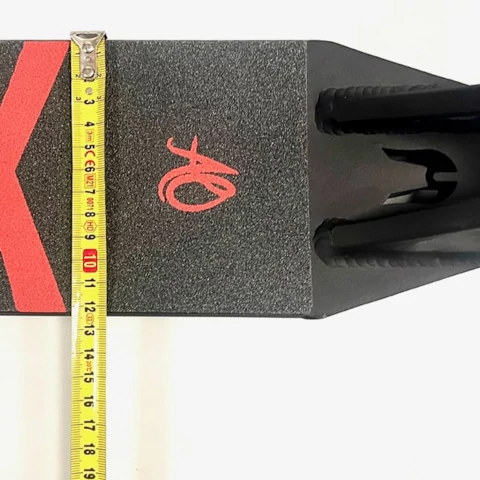
Decks are produced in various lengths and widths. Longer and wider decks are used for street riding, while shorter decks are preferred for park riding. The chosen length and width of the deck are, of course, also influenced by the rider's height. Usually, the taller the rider, the larger the deck dimensions. Although it is quite individual, it can be said that decks longer than 55 cm and wider than 15 cm can be considered street decks. Decks shorter than 51 cm and narrower than 13 cm are considered park decks. Decks between these values can be considered universal.
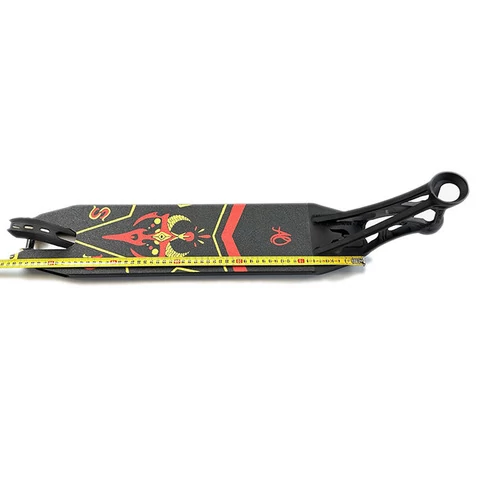

d) Compatibility with different wheel diameters
All currently available decks accommodate wheels with a diameter of 100 mm and 110 mm. Wheels with a diameter of 120 mm and 125 mm are compatible with a smaller number of decks. Wheels with a PU (rubber) width of 28 mm and 30 mm and 12STD wheels (12STD = 12 mm axle) are compatible with only a small number of decks.
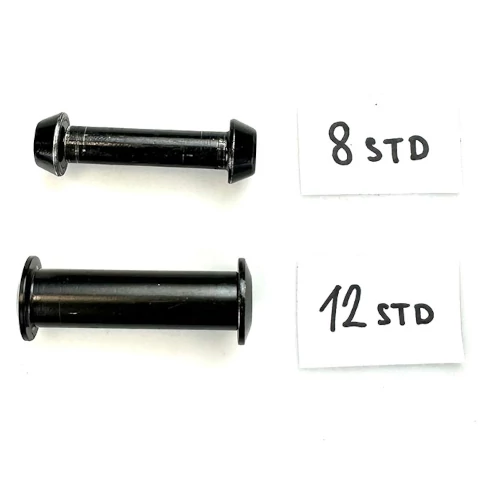
When choosing a deck, pay attention to the compatibility of the new deck with your existing wheels. Wheel compatibility is always stated in the product specifications.
HOW TO EXTEND THE LIFE OF A DECK
- Treat your scooter with respect. Don't throw it around.
- Grinding on rough surfaces (stone, concrete, railings) is very damaging to the deck. Therefore, seek out places that have already been "discovered" and are sufficiently worn down by previous riders.
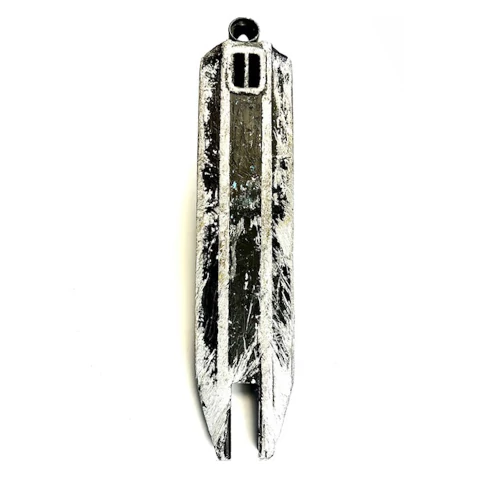
Unwaxed deck
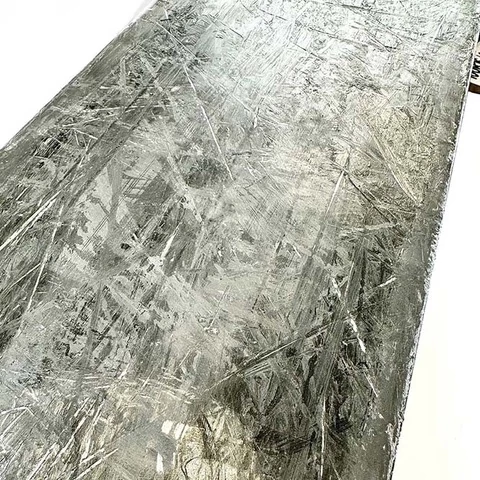
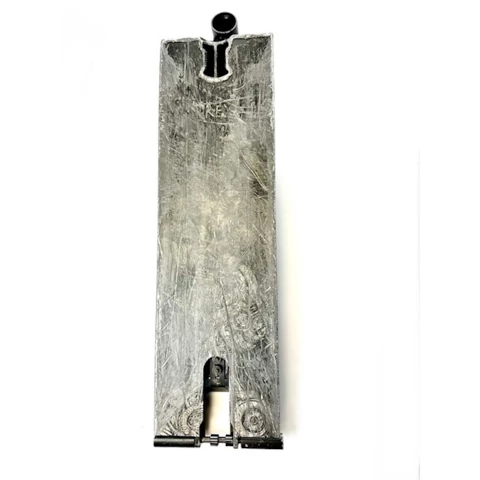
Waxed deck
- If you use a so-called peg-cut deck (the opposite of a box-end deck), then it is appropriate to use pegs. Instead of the deck, you wear down the peg. However, a peg is significantly cheaper than a deck.
- Wax the bottom of the deck. Waxing costs almost nothing and saves the bottom part of the deck (just as waxing saves the base of skis).
- Wax the obstacle too, if the park/spot rules allow it
- Do not ride with a loose brake or axle
- Ensure that all parts of the scooter are properly tightened (headset, rear axle). Loose screws destroy not only the bearings but also the deck.
- Do not ride in the rain or wet conditions
- Perform tricks cleanly. The more you cushion the landing with your knees, the more you save not only the deck but also your own joints.
- If you are riding in a skatepark, try to land on the sloped part of the obstacle; you will significantly dampen the load. The worst thing is to perform tricks called FLY-OUTS = landing off the ramp onto a flat surface.
- Do not lend your scooter to friends. They may weigh 30 kg more and have a completely different riding style
HOW TO CHOOSE THE RIGHT DECK
- Are you tall? Get a larger deck (and vice versa)
- Do you prefer street riding? Get a longer deck
- Do you prefer park riding? Get a shorter deck
- Will you frequently use the deck for so-called grinding without using pegs? Choose the widest possible deck with a flat bottom and box-ends
- Do you want a stronger deck? Choose a so-called monoblock deck