
COMPRESSION SYSTEMS
If you want to learn something about compression systems, you must first be willing to perform a now almost forgotten activity – reading.
The function of a compression system is to compress the headset. Hence the name compression system.
Description of different types of compression systems:
A compression system is very important; it has a noticeable impact on the overall functionality of the scooter.
Compression systems can be divided into two broad groups: threaded compression systems and threadless compression systems.
A MORE DETAILED BREAKDOWN IS AS FOLLOWS:
Compression system no. 1: Threaded fork + clamp (threaded system)
This is the oldest and most basic compression system, used for entry-level beginner scooters.
For children, this system is sufficient. However, from the parents' side, this system requires frequent maintenance, as it must be tightened regularly.
It is also the only compression system that uses a threaded fork. All other compression systems use threadless forks.
Compression system no. 2: ICS + clamp (threadless system)
What does ICS look like?
Long ICS
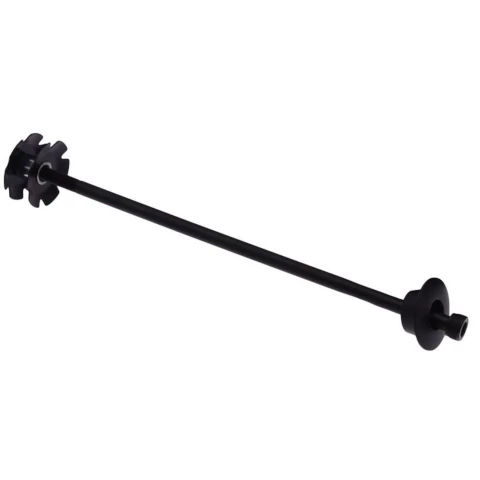
and short ICS:
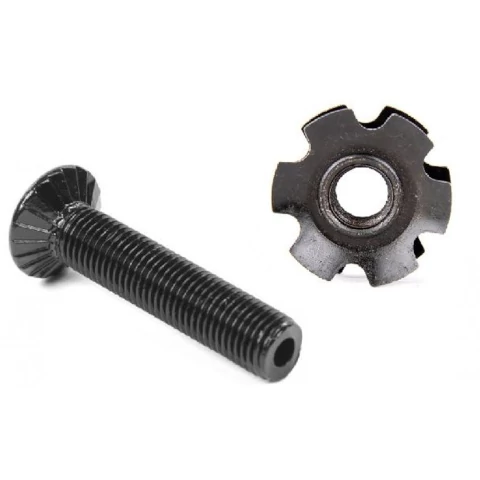
In the past, this was the most widespread compression system. Nowadays, it has been almost entirely replaced by more efficient compression systems, i.e., SCS, IHC, or HIC.
ICS is effectively a long or short bolt with a steel star nut. The star nut is located inside the handlebars.
What is the principle of ICS? The star nut "bites" into the inner part of the handlebar tube and acts as a fixation point into which a long bolt is screwed. This creates the fork-to-handlebar connection.
However, a problem arises with steel handlebars. The reason is obvious. A steel star nut is difficult to fix inside steel handlebars and has a tendency to loosen. This results in the disruption of the rigid connection between the fork and the handlebars.
The only exception is the ICS system from the well-known manufacturer Ethic. This system is perfectly functional because the star nut is welded inside the handlebars during production. However, this compression system only works within the Ethic product family.
The standard ICS system can therefore only be recommended for aluminum handlebars.
For the ICS compression system to function correctly: 1) the handlebars must be equipped with a slit at the bottom end of the tube, and 2) the outer diameter of the handlebar tube must be 31.8 mm for steel handlebars and 34.9 mm for aluminum handlebars.
The length of the fork tube protruding from the headset must be longer than the slit in the handlebars. A standard slit is 3.5 cm long. The length of the fork tube protruding from the headset should therefore be at least 4.5 cm long so that the slit is sufficiently reinforced by the fork tube and the handlebars do not break in the slit area. If the slit is longer, the fork tube must also be longer.
The ICS compression system is not compatible with HIC / oversized handlebars, which are made of steel and have an inner tube diameter of 31.8 mm.
You can watch the installation of the ICS compression system in the following video:
Compression system no. 3: HIC + clamp (threadless system)
This is the HIC compression system
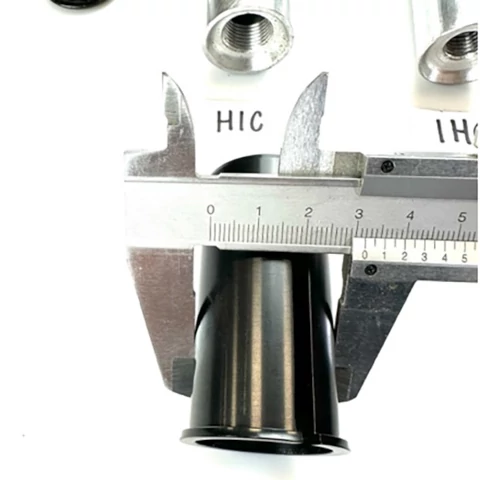
This compression system is only compatible with handlebars that have an inner diameter of 31.8 mm and an outer diameter of 34.9 mm.
If you do not have such handlebars, you cannot use the HIC compression system.
You can see what the HIC system looks like, how it works, and how it is installed in the following video:
A clear advantage of the HIC system over the ICS system is the stability of the *fork – handlebar* connection. The connection is permanently rigid and does not tend to loosen.
Disassembly and assembly of the handlebars are also easy. You loosen the clamp and remove the handlebars. The headset remains assembled.
The length of the fork tube must protrude from the headset by at least 4 cm but must not be longer than the HIC system itself.
If you eventually get tired of the HIC system, you can switch to the SCS system. You either remove the slit from the handlebars or insert a steel shim into the handlebars, which eliminates the function of the slit.
Compression system no. 4: IHC + clamp (threadless system)
What does IHC look like? The same as HIC, only it has a smaller diameter.
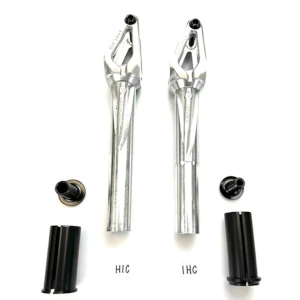
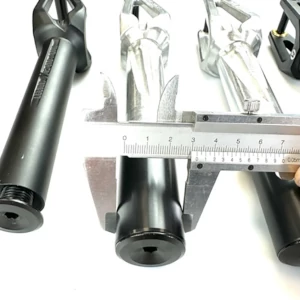
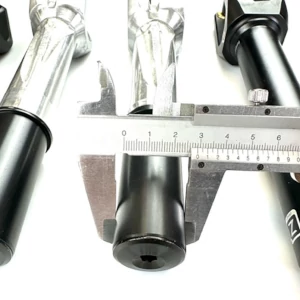
IHC is the most widespread compression system today.
This compression system is compatible with the following handlebars:
a) Steel handlebars, outer diameter 31.8 mm, handlebars have a slit at the bottom end of the tube
b) Aluminum handlebars, outer diameter 34.9 mm, handlebars have a slit at the bottom end of the tube
The IHC system differs from the HIC system precisely in that it can be used on handlebars that have a standard inner diameter.
A clear advantage of the IHC system over the ICS system is the stability of the *fork – handlebar* connection. The connection is permanently rigid and does not tend to loosen.
Disassembly and assembly of the handlebars are also easy. You loosen the clamp and remove the handlebars. The headset remains assembled.
The length of the fork tube must protrude from the headset by at least 4 cm but must not be longer than the IHC system itself.
We do not recommend combining the IHC system with another compression system, e.g., SCS or ICS.
The IHC system is only supplied with IHC forks. The IHC system can only be used on forks with a smaller tube diameter. This varies slightly by manufacturer, but it is approximately 25 mm.
Compression system no. 5: SCS (threadless system)
What does SCS look like? Like this.
In our opinion, SCS is the most efficient compression system. It is also the only compression system that eliminates the need for a clamp. The SCS is a "2-in-1" system, i.e., compression + clamp. Furthermore, the SCS system is very gentle on the headset bearings.
Installation of the SCS compression system:
Which handlebars are compatible with the SCS system? All of them. But for handlebars with a slit, it is necessary to remove this slit or insert a steel shim into the handlebars, which eliminates the function of the slit.
Handlebars used with the SCS compression system must NOT have a slit!! This is the basic rule that must be followed.
Most SCS systems are compatible with handlebars with an outer diameter of 31.8 mm and 34.9 mm. However, verify this information before purchasing an SCS.
SCS systems are usually supplied with a shim. For handlebars with an outer diameter of 31.8 mm, the shim is used; for handlebars with an outer diameter of 34.9 mm, the shim is not used.
THINGS THAT ARE ALSO GOOD TO REMEMBER
Using an SCS positions the handlebars approximately 4 cm higher. Therefore, if you buy 70 cm tall handlebars without a slit, their resulting height will be 74 cm.
However, if the handlebars have a slit and you decide to remove it (minus approx. 4 cm), you lose nothing from the original handlebar height. However, if you leave the slit on the handlebars and insert a steel shim, you gain an additional 4 cm of handlebar height.
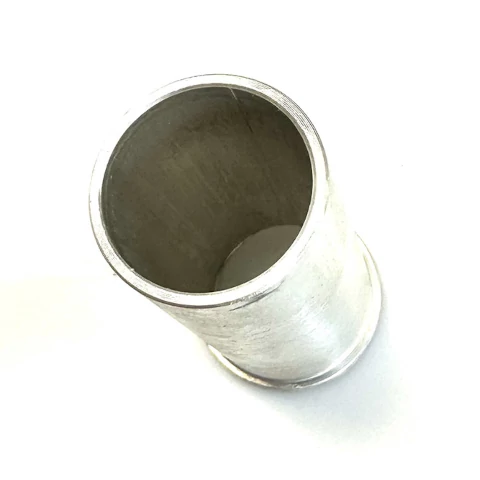
Why does someone use an HIC compression system instead of an SCS compression system? The argument is usually weight and price. An HIC compression system + clamp usually weighs less than an SCS.
However, the lifespan of an SCS is much longer than that of a clamp.
Additionally, SCS saves headset bearings.