
WHEELS
If you want to learn something about freestyle scooter wheels, you must first be willing to engage in a now almost forgotten activity – reading.
Wheels are one of the components of freestyle scooters. It is important to realize that while freestyle scooter wheels are designed for freestyle riding and are inherently durable, they are NOT indestructible. Just like any human activity, riding a freestyle scooter requires the use of one's gray matter. Then there is another option: you have to change the laws of physics or the periodic table of elements. :-)
Of all the components that make up a scooter, it is the wheels that are most sensitive to surface quality. Sharp edges, glass shards, small stones, etc., destroy (chip) the rubber of the wheels. This is not a defect in the wheels, but a defect in the surface you are riding on.
Wheels consist of three parts: the core, the PU (polyurethane), and the bearings.
The vast majority (99.5%) of wheels are compatible with an 8 mm axle diameter. Only a very small fraction (0.5% or less) of wheels are intended for use with 12 mm axles (8STD vs. 12STD).
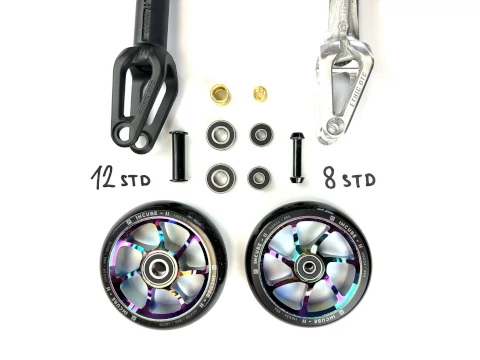
Spacers
We describe this issue elsewhere, in the Wheel Bearings section. It is worth noting here that when replacing bearings, it is advisable to keep your original spacers.
Wheel Cores
Wheel cores are made of either plastic or aluminum. Plastic cores are used only in very cheap wheels for beginners. The durability of a plastic core is limited. It can be said that wheels with plastic cores are intended only for beginner riders practicing basic tricks.
In contrast, aluminum cores are essentially unbreakable. The strongest are solid aluminum cores.
An important part of wheel manufacturing is the process of attaching the PU to the wheel core so that "dehubbing" does not occur—i.e., the PU falling off or detaching around the entire circumference of the core or a part of it. The resulting quality of the PU attachment to the core is influenced by the glue used, the composition of the PU, and the shape of the core groove in which the PU is seated.
We often hear questions like, "Which wheels are the fastest?". There is no single answer to that.
Several factors influence wheel speed:
- PU Hardness: The harder the PU, the faster the wheels should be.
- Wheel Rebound (or "bounce"): The more resilient the PU, the faster the wheel rolls.
- Condition of the bearings
- Wheel Diameter: The larger the wheel diameter, the faster the wheel is.
- Surface quality
- Your own conviction :-)
What does the PU Hardness rating mean?
PU hardness refers to the hardness of the polyurethane. For freestyle scooter wheels, PU hardness ranges from 85a to 91a. The standard is 88a. Harder PU does not necessarily mean a faster ride.
PU Hardness vs. Skatepark Riding
Is harder PU or softer PU more suitable for skatepark riding? The general opinion is that harder PU is more suitable, as it is faster and more aggressive in ramps. In contrast, softer PU is better for street riding. The wheels thus adhere better to the surface.
WHEELS CAN BE CATEGORIZED BY THE FOLLOWING CRITERIA
a) Diameter
100 mm, 110 mm, 115 mm, 120 mm, 125 mm. The larger the wheel diameter, the faster the wheel. The larger the diameter, the better the wheel handles minor surface irregularities.
b) Wheel Core Material
Plastic vs. Aluminum
c) PU Hardness
See description above.
d) Wheel Core Design
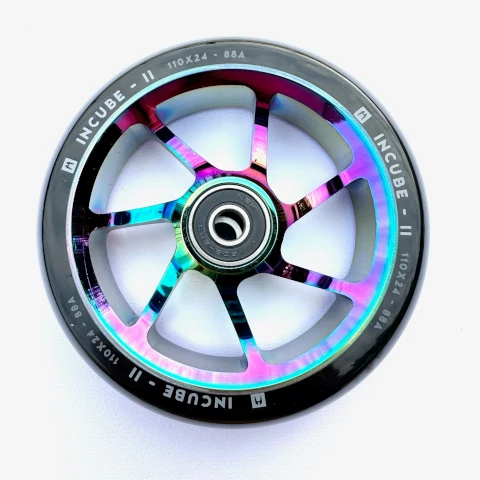
Wheel cores can be solid, spoked, or hollow.
Spoked cores are lighter than solid cores but are less strong.
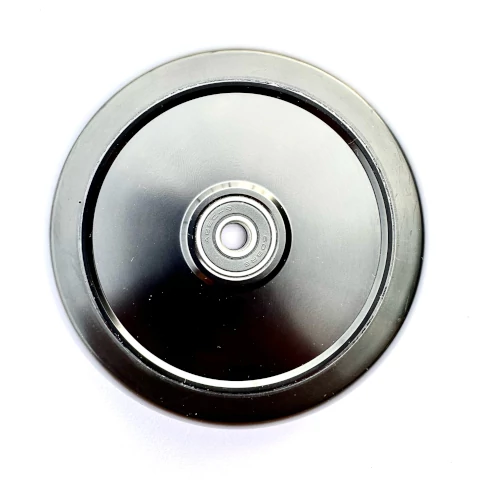
Hollow cores are lightweight, and thanks to the flat shape of the core, it is possible to apply attractive graphics. Hollow cores are less strong than solid or spoked cores.
HOW TO EXTEND THE LIFESPAN OF YOUR WHEELS
1) Treat your scooter with respect. Do not throw it.
2) Perform tricks cleanly. Proper landings are very important. Keep the landing as much in line with the axis of the trick as possible. Landings off-axis risk "dehubbing" the PU.
3) Avoid riding on poor-quality surfaces, i.e., no small stones, sharp edges, glass shards, etc.
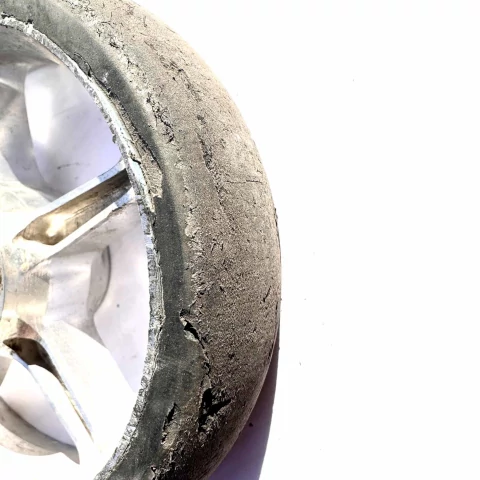
4) Do not drift! Drifting creates flat spots on the PU.
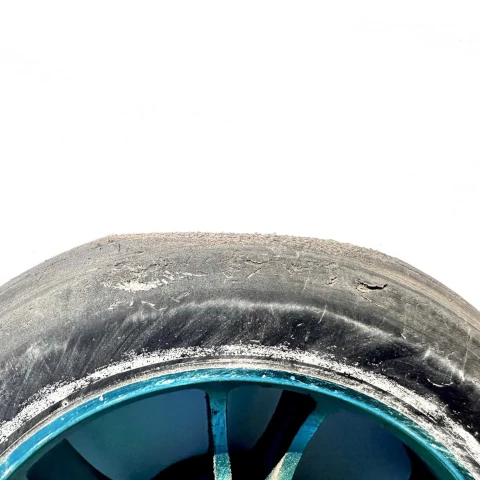
5) Use the brake the way it is intended. The brake is used for performing tricks! The brake is not used to stop the scooter immediately. Avoid long and continuous pressure on the brake. You risk creating flat spots on the PU and turning your wheel into a polygon. This is irreversible damage to the wheels.
6) Avoid riding through narrow longitudinal cracks. Narrow cracks can damage both the PU and the wheel cores.
7) Do not lend your scooter to friends. They may weigh 30 kg more and have a completely different riding style.
HOW TO CHOOSE THE RIGHT WHEELS
1) If you currently use 100 mm diameter wheels and want to switch to 110 mm wheels or even larger, make sure your current scooter setup (fork, deck, and brake) is compatible with that diameter.
2) Wheels with plastic cores are not the right choice.
3) If you prefer street riding, choose wheels with softer PU.
4) If you prefer park riding, choose wheels with harder PU.