
If you want to learn something, you must first be willing to perform a now almost forgotten activity – reading.
On a basic level, this holds true: Everything fits everything, but sometimes it needs a little help. This applies even to components from the same brand.
What is good to watch out for
1. Buying a new headset for decks with an integrated vs. standard headtube
For a deck with an integrated headtube, you need to purchase an integrated threadless headset. All dimensions of commonly available bearings are the same. The only problem can occur with the height of the cover cap, or top-cap. If the bearing seat in the headtube is too deep, the top-cap may rub.
This can be solved by:
a) removing the cap, which serves primarily an aesthetic function (if you ride in a clean and dry environment, nothing will happen to the bearings).
b) using thin spacers, which are inserted between the top cap and the compression ring. However, these spacers are quite hard to find.
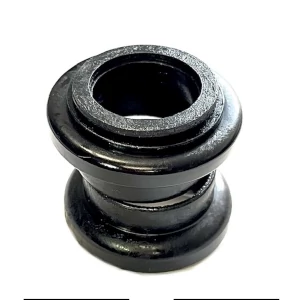
integrated headset
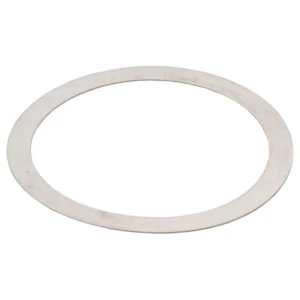
thin headset spacer
2. Buying a headset for scooters that use a threaded fork (cheap completes for beginners)
Here, you need to purchase a threaded headset (which uses ball bearings). Nowadays, however, this is an obsolete compression system, which is why threaded headsets have practically disappeared from the market. You might find them in a bike shop or bicycle repair shop (threaded headsets are the same for both bicycles and scooters). The price is around 100 CZK / 4 €.
There is also an alternative solution. It is possible to use a non-integrated threadless headset. In this case, you must use the original nut, which is placed above the new headset. See the tutorial on YouTube:
However, this is not an economical solution. By the time you need to replace your headset, your scooter will likely have a lower value than the cost of the cheapest threadless headset.
3. Wheel diameter vs. existing fork and deck
99% of new wheel sales consist of wheels with a diameter of 110 mm or more. Most users are therefore looking for larger wheels.
When switching to 110 mm wheels, you need to verify whether your current setup can accommodate wheels with a diameter of 110 mm (or 115, 120, or even 125 mm).
You must take into account both the fork and the deck and brake (especially for wheels with a diameter of 120 or 125 mm).
Basically, a visual inspection and a little common sense are enough. 110 mm wheels will "grow" by 5 mm in height within the fork.
Other dimensions that need to be monitored are the axle diameter and the wheel width. Currently, 8 mm and 12 mm axles (8std and 12std) and wheel widths of 24, 26, 28, and 30 mm are used. You can learn more about wheel dimensions in the "How to Choose Wheels" section.
The crucial question you must ask yourself is: Will the wheels fit there?
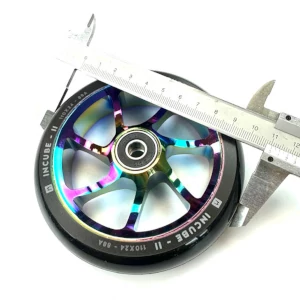
110mm 8std wheel
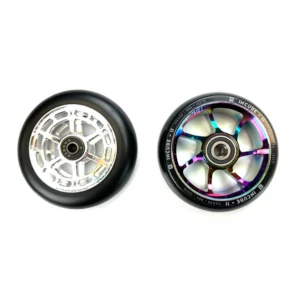
comparison of 115mm 8std wheel and 115mm 12std wheel
4. Buying a clamp vs. outer diameter of the vertical bar on the handlebars
Handlebars have two different outer diameters: 31.8 mm and 34.9 mm. When purchasing, make sure you are buying the correct clamp diameter for the correct handlebar diameter.
The diameter is stated for every clamp and set of handlebars. For handlebars, the outer (and inner) diameter is given, while for clamps, the inner diameter is given. You are interested in the outer diameter of the handlebars.
Most clamps today are supplied with a reduction (a so-called shim), which is a metal piece inside the clamp. This allows the clamps to be used for both handlebar diameters (the reduction is used for 31.8 mm handlebars, and it is not used for 34.9 mm handlebars).
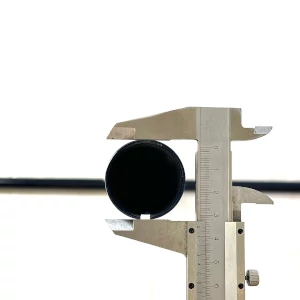
handlebars with 35mm outer diameter
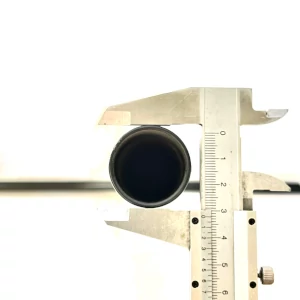
handlebars with 32mm outer diameter
5. Buying a brake for the deck
Brakes are sometimes a problem. There is no such thing as a universal brake. Different manufacturers handle brakes in different ways. Nowadays, most manufacturers offer replacement brakes for their decks, but it is still necessary to pay closer attention when selecting a brake.
Therefore, it is better to call or write before purchasing. Almost always, you can find a brake that will fit your deck.
6. Buying SCS vs. existing handlebars
These lines are intended for customers who are switching to SCS from another compression system.
First, it is necessary to realize what handlebars we actually have. Is the outer diameter of the handlebars 31.8 mm or 34.9 mm; do the handlebars have a slit or no slit (presumably "with"); are they aluminum, steel, or titanium?
a) Most currently available SCS are compatible with both handlebar diameters (SCS contains a reduction/shim). However, this must be verified in the product specification.
b) If you are buying an SCS with a reduction, you will use the reduction for 31.8 mm outer diameter handlebars, whereas you will not use it for 34.9 mm outer diameter handlebars.
c) Handlebars used with SCS must not have a slit!! The function of the slit can be eliminated in two ways:
- Cut off the slit with a hacksaw or an angle grinder
- Insert a reduction into the handlebars with the slit, which eliminates the function of the slit
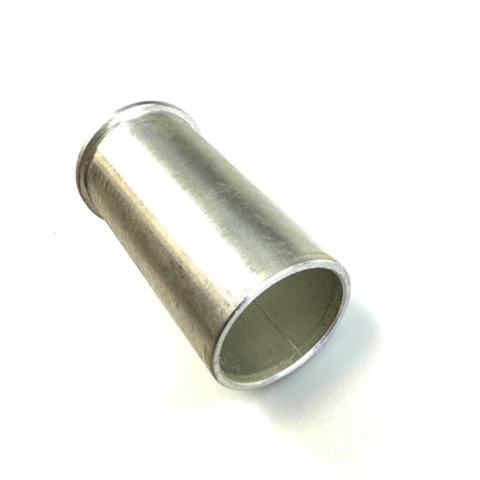
scs insert
With the second option, you will not lose about 4 cm of handlebar height. However, unless you need the highest possible handlebars, we recommend removing the slit.
Also, keep in mind:
Using SCS raises the handlebars by about 4 cm. If your current handlebars are 56 cm high including the slit, then by removing the slit, you remain at the same height. However, if you leave the slit in place and insert the reduction into the handlebars, you gain an extra 4 cm. The total height of the handlebars will then be 60 cm.
7. Buying HIC compression system vs. existing handlebars
CAUTION - do not confuse HIC and IHC! The systems function (and are named) similarly, but they differ quite significantly in the diameter of the handlebars and the fork tube. IHC is for handlebars with an inner diameter of 28.7 mm, while HIC is for handlebars with an inner diameter of 31.8 mm!
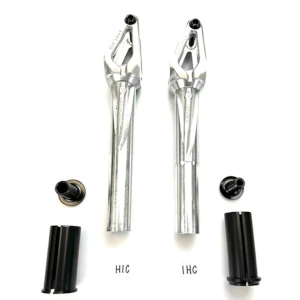
comparison of HIC and IHC forks
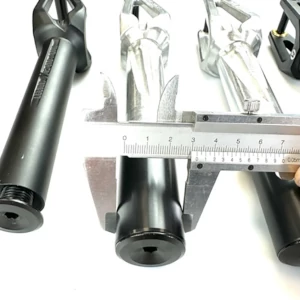
diameter of HIC shim
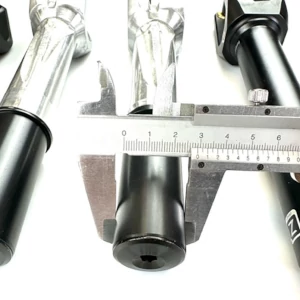
diameter of IHC shim
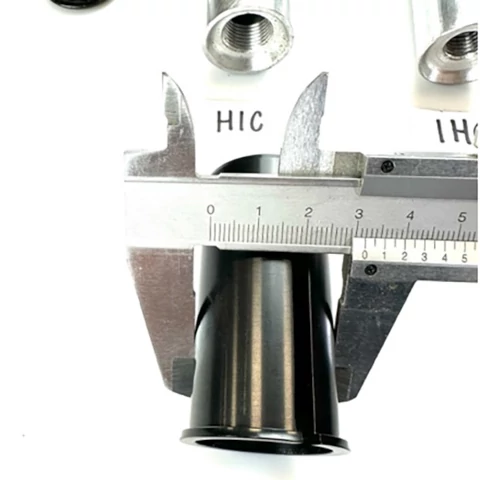
It is simple. If you want to use an HIC compression system, you must have steel or titanium handlebars with an INNER diameter of 31.8 mm and an outer diameter of 34.9 mm, which also have a slit.
The HIC system does not fit any other handlebars.
What does the HIC system look like?
8. Buying new handlebars vs. existing compression system
Related to points 6 and 7.
What is my current compression system? ICS, threaded fork, IHC, SCS, or HIC?
If you are getting Ethic handlebars, pay attention to the length of the fork tube. Older models have a star nut welded inside, and it would obstruct the deck if it has a shorter headtube.
What are my existing handlebars (outer diameter, inner diameter, do they have a slit)?
If you are buying new handlebars for an existing compression system, it is simple. Determine what type of handlebars you have (inner diameter / slit) and buy the same type of handlebars from your preferred brand.
Note: If you want to switch to SCS or HIC compression systems, follow points 6 and 7.
9. Buying a new fork
When choosing a new fork, you need to pay attention to which compression system you are currently using. If you are using SCS, you will not buy an ICS fork (even though it could be modified for use with SCS, it makes no sense to complicate your life with that).
Different deck manufacturers use different headtube lengths (or heights). If you have a deck with a short headtube (e.g., MGP), there may be an issue with an SCS fork that is too long (specifically, a long fork tube).
This problem can be solved by using spacers or shortening the fork if the SCS allows it. You can find headset spacers on the Gizmania website here:
The standard length of a non-integrated headtube is 9 cm (incl. headset 10.5 cm). The standard length of an integrated headtube is 10 cm (incl. headset 10.5 cm). Most forks are manufactured for this dimension. For any other headtube length, you need to first determine the compatibility of the fork and the deck. This is also related to the note in point 6: Decks with a short headtube cannot be combined with Ethic handlebars that have an ICS star nut welded inside the tube.
10. Threaded forks and pegs
We definitely do not recommend using pegs on a scooter equipped with a threaded fork.
Threaded forks are manufactured for basic types of scooters for beginners, and therefore the fork frame is not adapted for pegs. Pegs represent an additional lever that the threaded fork frame usually cannot withstand, and the fork may bend.
And furthermore, if someone has a scooter with a threaded fork, they are a beginner. And for beginners, pegs are more of a hindrance.